
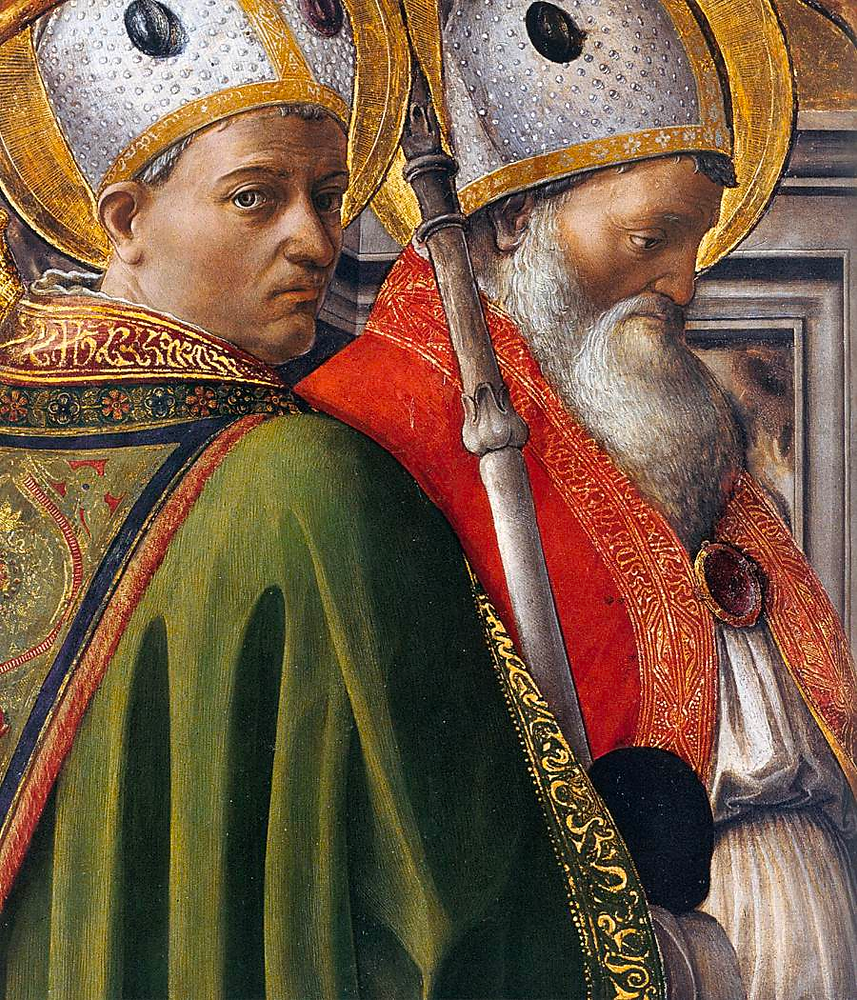
Ambrose (AD 340-397) became the Bishop of Milan in 374. He wrote On the Duties of the Clergy around 391 to encourage the clergy of his diocese so that they would conduct their lives in a manner appropriate to their calling. With his vast background in the Greek and Roman Classics, Ambrose modeled his work on Cicero’s De Officiis. Therefore, the Latin title of his pastoral treatise for the clergy of his diocese is De Officiis Ministorum.
Augustine (AD 354-430) was teaching in Milan when he met Ambrose. Augustine listened to Ambrose preach from the Scriptures. And the more intently that Augustine listened to Ambrose’s skilled preaching, the more Augustine began to reconsider his own doubts about Christianity. This is why St. Ambrose is referred to as the saint who converted St. Augustine.
Augustine eventually became the Bishop of Hippo in 395. He wrote his best known work Confessions over the years 397-401. It was during this same time period that Augustine also wrote On Christian Teaching (De Doctrina Christiana). Interestingly, while providing an outline for teaching Christian theology, Augustine’s work also suggests how Cicero’s philosophy of rhetorical principles can assist in teaching theology.
Whereas Ambrose and Augustine continue to offer guidance for today’s pastors and teachers, there are many other early Church Fathers who also offer guidance. The following two books are helpful introductions to the Church Fathers. They both also provide suggestions for further study of secondary and primary sources.
- Ancient Wisdom for the Care of Souls: Learning the Art of Pastoral Ministry from the Church Fathers by Coleman Ford and Shawn Wilhite
- The Fathers of the Church: An Introduction to the First Christian Teachers (Third Edition) by Mike Aquilina
~ Boethius ~