
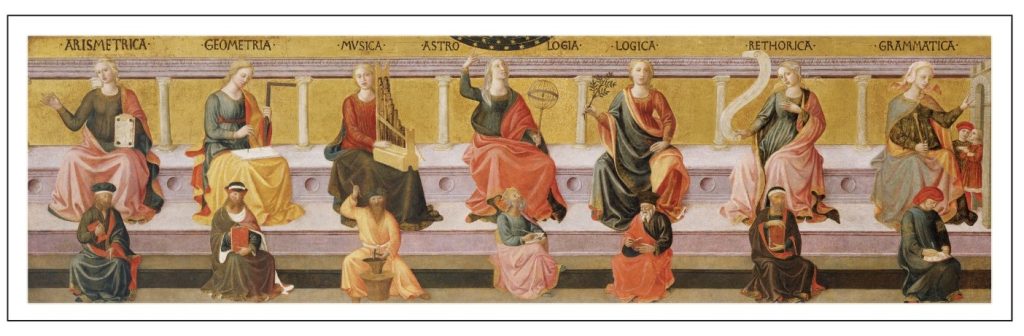
Literacy can be defined as the human ability to read and write. The majority of people who can read and write do read and write. By this I mean they do more than just read and write. They also cultivate their reading and writing skills to a level of contemplative thought and informative communication.
Numeracy can be defined as the human ability to understand and work with numbers. The term was coined in the middle of the twentieth century to mean a numerical literacy and competence with basic mathematics. Nevertheless, basic mathematics is more than arithmetic alone. Mathematical literacy includes geometry, spatial relationships, and discerning accurate numerical data from inaccurate numerical data.
Recall that in Classical Greece, there was no demarcation between mathematics and philosophy. Both math and philosophy were studied together. Only recently in educational history have we tried to separate them. However, much like the traditional “3 Rs” in education today (reading, writing, and arithmetic), classical education continues to study the “Trivium” (grammar, logic, and rhetoric) and the “Quadrivium” (arithmetic, music, geometry, and astronomy). Together the trivium and the quadrivium are known as the seven liberal arts.
In Part 2 we will underscore the importance of literacy and numeracy to philosophy by discussing calculus as the mathematics of change. I will recommend several books to supplement our discussion of calculus. In the meantime, I recommend Math for English Majors: A Human Take on the Universal Language by Ben Orlin for an enjoyable introduction to literacy and mathematical literacy in a single volume.
~ Boethius ~