
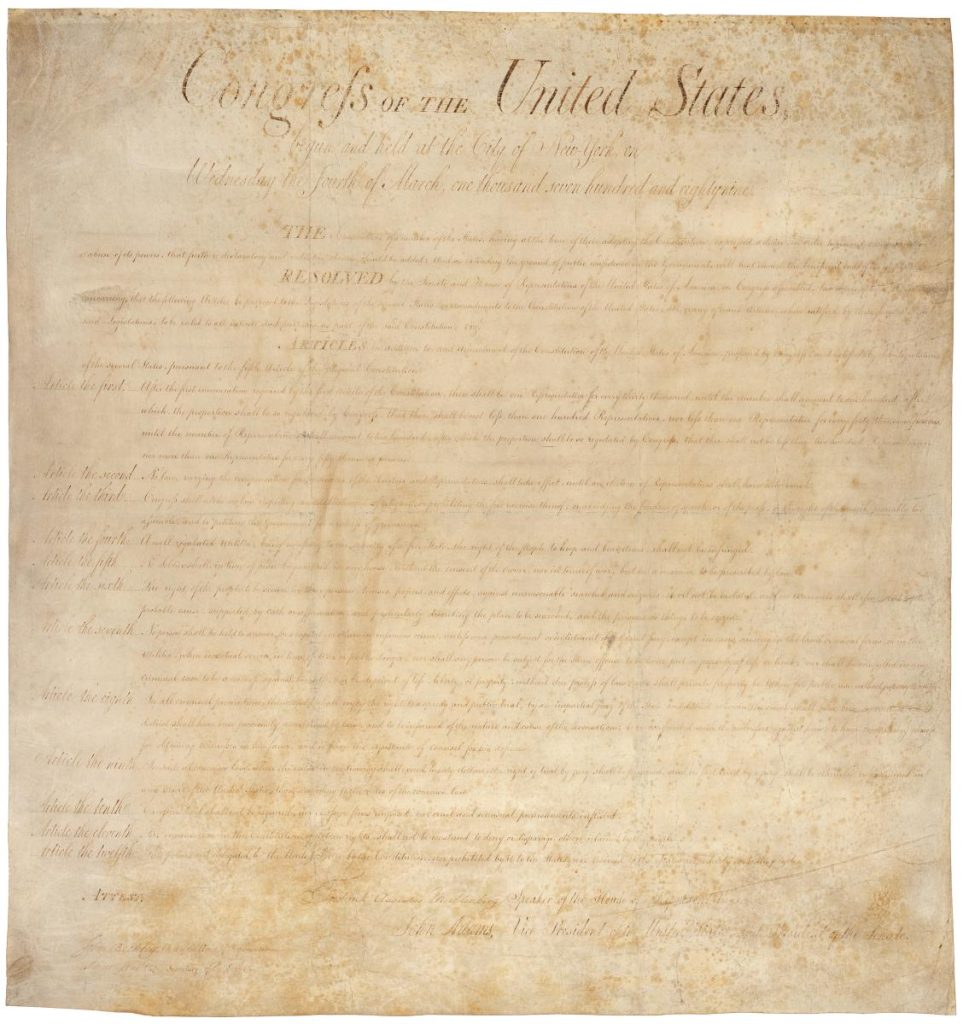
Congress shall make no law respecting an establishment of religion, or prohibiting the free exercise thereof; or abridging the freedom of speech, or of the press; or the right of the people peaceably to assemble, and to petition the Government for a redress of grievances. (The 1st Amendment of the U. S. Bill of Rights)
According to the National Archives, on September 25, 1789, the First Congress of the United States proposed 12 amendments to the Constitution. Ten of the proposed 12 amendments were ratified by three-fourths of the state legislatures on December 15, 1791. The ratified Articles (Articles 3–12) constitute the first 10 amendments of the Constitution, or the U.S. Bill of Rights. In 1992, 203 years after it was proposed, Article 2 was ratified as the 27th Amendment to the Constitution. Article 1 was never ratified.
Together with the Declaration of Independence and the Constitution, the Bill of Rights is the third of three documents known collectively as the Charters of Freedom. These three documents have secured the rights of the American people for more than two and a quarter centuries. Furthermore, these documents are instrumental to the founding philosophy of the United States.
It is worth noting that freedom of religion is the first right secured by the first amendment. Both the freedom of speech and of the press are secured as rights immediately following the freedom of religion. Therefore, the rights to think, speak, and write are to be freely exercised and unabridged.
When it comes to philosophy and theology, these freedoms are crucial not only in private homes and places of worship. These freedoms are also crucial in the public square and within academia. And if we are to love wisdom and to seek the truth, then we must also cherish and protect our rights to think, speak, and write freely.
~Boethius~